On 31 March 2026 the Reserve Bank of Australia published the Conclusions Paper of its Review of Merchant Card Payment Costs and Surcharging. From 1 October 2026, Australian businesses will no longer be able to add a surcharge to eftpos, Mastercard or Visa payments — debit, prepaid or credit. On the same day, the cap on interchange fees for domestic consumer credit cards drops from 0.8 per cent of transaction value to 0.3 per cent.
The Payments System Board’s position is that these two changes belong together: take away the surcharge, and give merchants lower wholesale costs to compensate. The RBA estimates the interchange reductions are worth about $910 million a year to merchants, against roughly $1.8 billion a year in card surcharges that will disappear, of which consumers currently pay about $1.6 billion.
Those two numbers do not net out to zero for everyone. Around 16 per cent of merchants surcharge; they lose a revenue line and gain a cost reduction that, for most of them, is smaller. The other 84 per cent gain the cost reduction and lose nothing — if their payment provider passes it on. Whether that happens is the whole question, and the international evidence the RBA itself collected is not encouraging.
This is the first of three pieces on the economics of running a small business in Australia. It deals with the cost of taking money from a customer: what a small operator pays, how that compares to a large one, what changes in October, and how sound the research is that underpins the argument that cash is now the expensive option.
What changes on 1 October 2026
The reform package has four parts. Only the first two bite this year.
| Change | From | To | Effective |
|---|---|---|---|
| Surcharging on eftpos, Mastercard, Visa (debit, prepaid, credit) | Permitted up to cost of acceptance | Removed | 1 Oct 2026 |
| Interchange cap, domestic consumer credit | 0.8% | 0.3%, benchmark abolished | 1 Oct 2026 |
| Interchange cap, domestic debit and prepaid | 10c or 0.2% | 8c or 0.16%, benchmark held at 8c | 1 Oct 2026 |
| Interchange cap, domestic commercial credit | 0.8% | 0.8%, benchmark abolished | 1 Oct 2026 |
| Interchange cap, foreign-issued cards | Unregulated | 1.0% | 1 Apr 2027 |
| Acquirers publish merchant service fees quarterly | Not required | Required for large acquirers | 1 Oct 2026 |
| Acquirers publish a measure of interchange pass-through | Not required | Required, four quarters | First data 30 Jan 2027 |
| Merchant statements to break out foreign-issued and online costs | Not required | Required | 1 Apr 2027 |
The debit change is close to cosmetic, and the RBA says so. The weighted-average interchange fee on domestic debit has already fallen to around 6 cents per transaction, below the existing 8 cent benchmark and well below the 10 cent cap. Competition between eftpos and the international debit networks got there without regulation. Lowering the cap to 8 cents constrains a rate almost nobody is charging.
The consumer credit change is the real one. The average interchange rate on consumer credit is 0.47 per cent, but that average hides a wide spread: small merchants pay rates at or near the 0.8 per cent cap, while the largest merchants receive negotiated “strategic” rates as low as 0.18 per cent. The RBA’s Issuer Cost Study put the eligible costs an issuer incurs on a consumer credit transaction at roughly 0.2 per cent. Everything above that has been funding rewards programs — and the merchants funding it most heavily are the ones with no bargaining power.
The RBA is not banning surcharges
The mechanism is worth getting right, because the plain-English description in most coverage is wrong. The RBA has no power to stop a merchant charging whatever it likes. What it has is a standard that stops the card networks from stopping them.
Since the early 2000s, RBA Standards have prohibited eftpos, Mastercard and Visa from imposing “no-surcharge rules” on the merchants that accept their cards. On 1 October the RBA lifts that prohibition. The networks are then free to reinstate the no-surcharge rules they have always wanted, and the RBA expects them to do so promptly — that is how it happened in other jurisdictions, and the schemes’ commercial interest is obvious. The Conclusions Paper adds that if surcharging somehow continues after the prohibition is lifted, “the RBA could recommend that the Government legislate a ban”.
Two consequences follow from the fact that this is scheme rules rather than law. American Express is a three-party network and is not designated, so it is not covered: merchants will still be able to surcharge Amex after October. Buy now, pay later products are also outside the scope. The RBA has flagged a further consultation starting in mid-2026 covering Amex, BNPL, mobile wallets and e-commerce platforms, following the 2025 amendments to the Payment Systems (Regulation) Act 1998. Until that concludes, the checkout rule is: you may surcharge the expensive three-party card and not the cheaper four-party ones.
What a small merchant pays
The RBA defines a small merchant as one whose acquirer processes $1 million or less a year in eftpos, Mastercard and Visa transactions. On its own data, drawn from more than a million merchants across eight large payment providers:
- A small merchant on a single-rate plan pays an average of 1.4 per cent of transaction value.
- A small merchant on an unblended (“interchange plus”) plan pays an average of 0.9 per cent.
- A large merchant pays an average of 0.6 per cent.
- Only 19 per cent of small merchants are on unblended plans. Around three-quarters of all merchants are on single-rate or blended plans.
The half-percentage-point gap between the two small-merchant figures is not a discount for scale. It is the price of a pricing plan that is easy to understand. Single-rate plans quote one number for every card — Square Australia charges 1.6 per cent on any card presented in person for sellers who signed up on or after 30 May 2024, and 2.2 per cent online; Zeller charges 1.4 per cent in person for all cards including Amex, and 1.7 per cent plus 25 cents on invoices. An unblended plan passes through the actual interchange and scheme fee on each transaction plus a margin, which is cheaper on average and impossible to forecast.
Most small operators buy the certainty. That choice is also what makes the interchange reduction least likely to reach them, for reasons covered further down.
The claim that cash costs more
Running underneath the whole reform is a proposition that has become close to conventional wisdom: cash is no longer the cheap payment method. The Conclusions Paper states it three times — that “cash is no longer clearly cheaper for merchants to accept than debit or credit cards, with the cost of each cash transaction having risen as consumer use has declined”. It is one of the stated grounds for removing surcharging, on the logic that a surcharge which steers customers towards cash steers them towards the more expensive instrument.
All three statements carry the same footnote: See Mastercard (2025). That is Mastercard’s own submission to the Review, lodged on 15 January 2025. Read that submission and the evidence resolves one step further: it cites “a Boston Consulting Group (BCG) quantitative research study commissioned by Mastercard in August 2024”, and reports its headline finding — that the end-to-end cost of accepting a card in Australia is 1.8 per cent, against 3.9 per cent for cash.
So the central factual claim used to justify removing a merchant’s ability to price-signal against cards rests, in the RBA’s own citation chain, on research commissioned by one of the two card networks whose fees are the subject of the Review. That does not make the numbers wrong. It does mean they deserve to be read closely, which is what follows.
What the study measured
BCG surveyed more than 1,600 SME merchants across 15 markets in Europe and the Asia-Pacific, including Australia and New Zealand, and computed an “end-to-end” cost for each payment instrument in three layers: direct costs (fees paid to providers, cash deposit and cash-in-transit charges), indirect costs (terminals, tills, safes, and losses from theft and error) and back-office costs (reconciliation, till preparation, walking the takings to the bank).
For Australia in-store, the weighted figures are 1.8 per cent for four-party cards, 3.9 per cent for cash and 5.3 per cent for buy now, pay later. Within the 3.9 per cent for cash, the two largest lines are reconciliation at 1.89 per cent and shrinkage — handling errors and theft — at 1.10 per cent. The fees a bank charges — cash deposit and cash-in-transit — total 0.25 per cent.
The headline comparison is an average across merchant sizes. Split by size, it looks different.
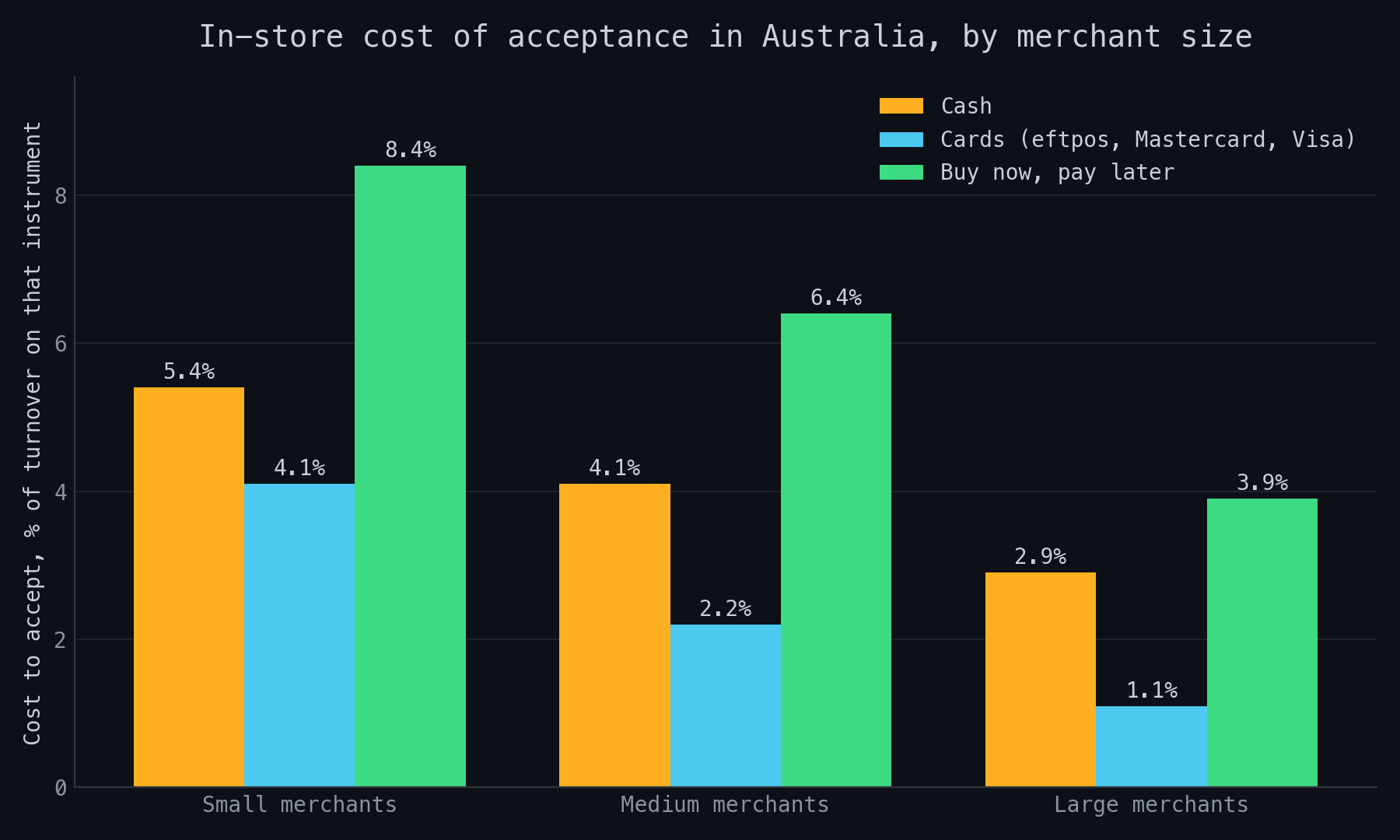
A large merchant pays 1.1 per cent for cards and 2.9 per cent for cash — cash is 2.6 times dearer. A small merchant pays 4.1 per cent for cards and 5.4 per cent for cash, a ratio of 1.3. The “cards are less than half the cost of cash” finding is largely a large-merchant finding. BCG says as much: large merchants report acquirer fee discounts of up to 90 per cent relative to small merchants, and their total cost of acceptance is 45 to 75 per cent lower.
Inside the small merchant’s card cost
The 4.1 per cent that BCG attributes to card acceptance for a small Australian merchant is worth taking apart, because it is not made of fees.
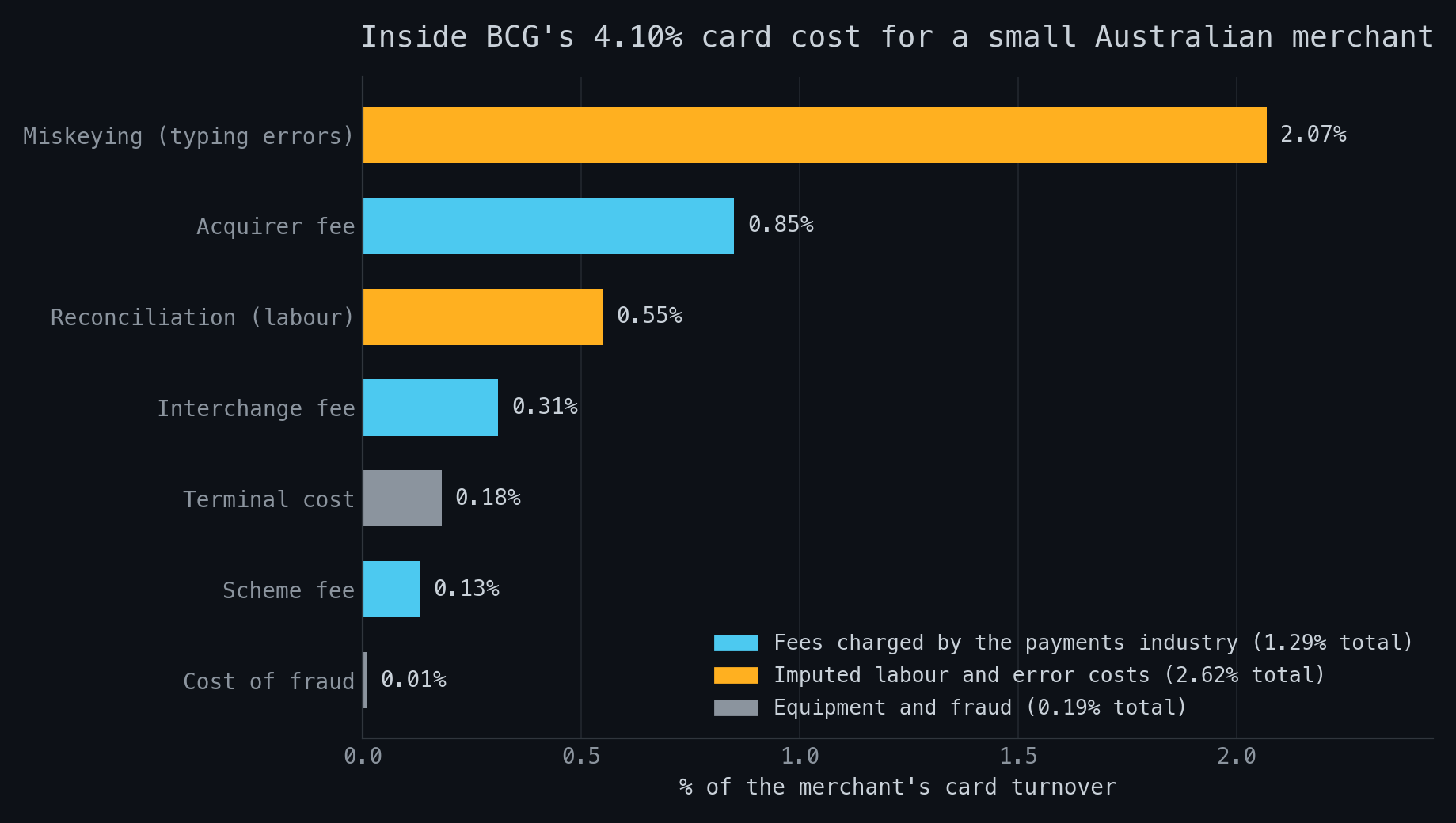
Interchange, scheme fees and the acquirer’s margin come to 1.29 per cent. Terminal cost adds 0.18 per cent and fraud 0.01 per cent. The remaining 2.62 per cent is imputed labour and error: 0.55 per cent for reconciliation, and 2.07 per cent — more than half the whole figure — for miskeying. BCG’s explanation for why large merchants score better is explicit: integrated payment systems reduce miskeying costs, and under 20 per cent of small merchants have integrated systems. The small merchant’s terminal is a separate box, and someone types the amount into it by hand.
Miskeying is a real cost. Treating it as a cost of card acceptance is a modelling choice with consequences. On a shop turning over $500,000 on cards, 2.07 per cent is $10,350 a year in mistyped amounts — an error rate most operators would notice at the end of a week, let alone a year. The same staff member entering the same figure into a cash register makes the same error; in the cash column that error appears as part of the 1.10 per cent “shrinkage” line, at roughly half the rate. And it is the one component in the list that a merchant can eliminate outright by integrating the terminal with the point-of-sale system, which has nothing to do with whether cards or cash are cheaper.
The denominator problem
The deeper issue is arithmetic. Each figure is expressed as a percentage of the turnover taken on that instrument. The bulk of the cost of cash — reconciliation, till preparation, the trip to the bank — is close to fixed. A shop counts its float and balances its till at close whether it took $2,000 in notes that day or $200.
Divide a fixed cost by a shrinking base and the percentage rises with no change in the underlying dollars. The RBA states this mechanism plainly: the cost of each cash transaction has risen “as consumer use has declined”. That sentence describes a denominator, not a cost increase. It is the arithmetic of a declining share, and it will keep pushing the percentage up until the last cash transaction is infinitely expensive.
The comparison this makes possible is misleading in a specific way. For a business already doing the daily count, the marginal cost of accepting one more cash transaction is close to zero — the note goes in the drawer and gets counted with the others. The marginal cost of accepting one more card transaction is a fee that scales exactly with the amount, every time, forever. Average cost and marginal cost point in opposite directions here, and the decision a merchant faces at the counter is a marginal one.
None of this means cash is free. Retail banks charge to deposit coin, cash-in-transit is a genuine expense for anyone using it, and a shop holding notes overnight carries a risk a card terminal does not. It means the specific claim — that cash has become dearer than cards for a small merchant — is carried by a self-reported survey of merchant labour estimates, funded by a card network, measured in a unit that guarantees the result trends in one direction.
Whether the savings arrive
A lower interchange cap reduces what the acquirer pays the card issuer. It does not, by itself, reduce what the merchant pays the acquirer. On an unblended plan the reduction flows through automatically, because the merchant is charged interchange at cost. On a single-rate plan the acquirer simply keeps a wider margin unless competition forces it out.
The RBA collected the international record on this, and it is not good:
- European Union. Following the 2015–2016 Interchange Fee Regulation, the European Commission found 45 per cent of the interchange reduction reached merchants. Higher acquirer margins absorbed another 45 per cent and scheme fees took 10 per cent.
- United Kingdom. The Payment Systems Regulator found small and medium merchants experienced little-to-no pass-through from the same regulation, because acquirers and networks raised other fees. Large merchants on blended plans did get full pass-through — but the saving was small, because Visa raised interchange on high-value transactions after the rules took effect.
- New Zealand. The Commerce Commission estimated merchants received around 90 per cent of the savings from the 2022 reductions, helped by acquirers automatically moving merchants onto unblended pricing.
- Canada. Mastercard and Visa agreed with the government to cut small-business interchange from 2024. Only some acquirers said they would pass the savings on.
- Australia, 2003. The RBA’s original credit interchange reform cut average interchange by 0.4 percentage points; average merchant service fees fell 0.35 percentage points, from 1.4 to 1.05 per cent. Close to full pass-through, in a market with far fewer providers than today.
The pattern is consistent: pass-through is high where merchants are on unblended pricing, and poor where they are on flat rates. Around three-quarters of Australian merchants are on single-rate or blended plans, and they are disproportionately the small ones. The RBA acknowledges this directly, noting it “has not received evidence” that Australian card acquiring is more price competitive than the overseas markets that saw only moderate pass-through.
Faced with that, the Board consulted on nine options and adopted the two lightest. Large acquirers must publish a measure of interchange pass-through for the first four quarters from 1 October 2026, and must give the RBA a breakdown of their merchant service fees into interchange, scheme fees and margin. The RBA will republish the pass-through figures to “draw attention to those that do not pass on the savings”.
It declined to require acquirers to offer unblended plans (Option 8), on the grounds that small merchants prefer flat rates and might not take them up. It declined to regulate acquirer margins directly (Option 9) as “highly interventionist and unwarranted”. It declined to build a comparison website (Option 4) because the plans are too varied to compare — which is a fair description of the problem and an odd reason to leave it unsolved.
The enforcement mechanism for the entire reform, in other words, is a published table and the hope of embarrassment. The RBA says it “stands ready to take further regulatory action”, and could revisit Options 8 and 9 at the review starting mid-2026.
The arithmetic for one shop
Take a café turning over $600,000 a year, 85 per cent of it on cards — $510,000 of card turnover. On the RBA’s merchant-level data, merchants that do not surcharge run about 66 per cent of card value through debit, so roughly $173,000 is consumer credit.
Today, on a 1.4 per cent single-rate plan, the card fees are about $7,140 a year.
After October, if this merchant sits at the current 0.8 per cent credit interchange cap and the reduction to 0.3 per cent is passed through in full, the saving is 0.5 percentage points on $173,000 — about $865 a year. The debit cap change contributes almost nothing, because the effective rate is already around 6 cents. Call it 0.17 percentage points off a 1.4 per cent plan.
Now suppose the same café currently surcharges at 1.4 per cent to recover those fees. That surcharge is worth $7,140 a year in revenue it will lose on 1 October. The interchange saving replaces about 12 per cent of it. The remaining $6,275 has to come out of margin or go onto the menu, which is precisely what the RBA expects: the Conclusions Paper anticipates that the 16 per cent of merchants who currently surcharge “may increase their advertised prices to cover the cost of accepting card payments”.
Set against that, the single largest lever available to this café is not the reform at all. Moving from the average small-merchant single-rate plan (1.4 per cent) to the average small-merchant unblended plan (0.9 per cent) is worth about $2,550 a year — roughly three times the interchange saving, available today, requiring nothing but a phone call and a tolerance for variable pricing. The reform’s most valuable component for a small operator may be the requirement that acquirers publish their fees, which is what makes that phone call informed.
One more figure from the RBA’s own analysis deserves to be read by anyone who has ever set up a surcharge. Controlling for acquirer, industry and merchant size, merchants that surcharged had a 0.9 percentage point lower credit card share of payments. On $1 million of card turnover, that steering effect saves the merchant $36 a year. The surcharge recovers a cost; as a price signal, which is the reason it was permitted in the first place, it does essentially nothing.
Cash use has stabilised
The efficiency case for removing surcharges assumes a payments system converging on cards. The RBA’s own 2025 Consumer Payments Survey, published in the April 2026 Bulletin — a month after the Conclusions Paper — reports something else.
Cash use has stabilised. Around 15 per cent of payments by number were made in cash in 2025, up from about 13 per cent in 2022. For in-person payments the share is 19 per cent by number and 16 per cent by value. Roughly one in four payments under $10 is cash. Cash use held steady or rose across every spending category, and across age, income and location groups. ATM withdrawals and lodgements at cash-in-transit depots corroborate the survey.
The Conclusions Paper cites the same survey to make the opposite point, noting that cash “declined to around 15 per cent of in-person transactions in 2025 from 69 per cent in 2007”. The long-run direction is not in dispute. But the comparison that matters for a policy taking effect in 2026 is with 2022, and against 2022 the number went up.
The survey also found that one-third of Australians would face hardship or major inconvenience if cash became hard to access. Among heavy cash users that rises above 70 per cent; among people who use cash for less than a fifth of their transactions it is still around 25 per cent.
Two other things are happening at once, and they point in opposite directions from the RBA’s reform.
The Commonwealth has been propping cash up. From 1 January 2026 most large retailers of groceries and fuel must accept cash for in-person transactions of $500 or less between 7am and 9pm, under a mandate announced on 14 December 2025, to be reviewed after three years. Businesses with aggregate annual turnover under $10 million are exempt unless they share a trademark with a larger retailer. Given the ATO’s small-business threshold is the same $10 million, and 98 per cent of Australian businesses fall under it, the mandate covers around 2 per cent of businesses by number. On ASBFEO’s compilation of ABS data, there were 2,729,648 actively trading businesses at 30 June 2025, of which 50,854 turn over $10 million or more.
On 2 July 2026 the government introduced the Cash Distribution Framework Bill 2026, regulating cash-in-transit as critical infrastructure with ACCC oversight of service terms and RBA crisis powers. It follows the near-failure of Linfox Armaguard, which merged with its main national competitor, Prosegur Australia, under ACCC merger authorisation in 2023, and then required rescuing. In June 2024 its own major customers — ANZ, Commonwealth Bank, NAB, Westpac, Australia Post, Coles, Wesfarmers and Woolworths — agreed a $50 million, 12-month support package conditional on Armaguard meeting monthly performance targets, coordinated by the Australian Banking Association under ACCC authorisation. The country’s cash logistics now run on a single company that its customers have to subsidise to keep alive.
Meanwhile the infrastructure that lets a small business bank its takings keeps shrinking. APRA’s Points of Presence statistics, released 16 October 2025, show bank branches fell 4.6 per cent in the year to June 2025. BCG puts “walk cash to bank” at 0.62 per cent of cash turnover — a labour cost that rises directly with the distance to the nearest branch, and one of the few components of the cost of cash that is genuinely, measurably increasing.
The picture is not a state eradicating cash. It is a state legislating to keep cash available at the checkouts of the largest retailers and underwriting the trucks that move it, while its central bank removes the one mechanism by which a small merchant could price the difference between instruments — and while the branch network that small merchant depends on closes at nearly 5 per cent a year.
Limitations of this analysis
The cost figures for cash and cards by merchant size come from a single study, commissioned by an interested party, based on merchants’ self-reported estimates of their own labour and losses. There is no independent Australian dataset of comparable scope. Where I have criticised the study’s method, that criticism applies to the direction and magnitude of its estimates, not to the existence of the costs it measures.
The RBA’s merchant service fee figures are averages across more than a million merchants, and the spread within each category is wide. A specific business may pay well above or below them.
The worked example above assumes a card mix taken from the RBA’s cross-merchant average, a merchant currently at the interchange cap, and full pass-through. Each assumption is favourable to the reform; a merchant already receiving interchange below the cap will see less.
Pass-through will not be observable until the first acquirer publications on 30 January 2027, covering the December 2026 quarter. Every statement here about what merchants will receive is a projection from other jurisdictions.
What to do before October
- Find your current effective rate. Divide total merchant fees for the last twelve months by total card turnover for the same period. That is the number to compare, not the rate you were quoted.
- Establish whether you are on a single-rate, blended or unblended plan. If your statement shows one rate for everything, you are on a single-rate plan and will not receive the interchange reduction automatically.
- Get your card mix from your provider — debit versus credit, in person versus online, domestic versus foreign-issued. You cannot obtain an accurate quote from a competitor without it, and from 1 April 2027 your provider must give it to you on the statement.
- Check the RBA’s published merchant service fees after 30 October 2026 and the pass-through figures after 30 January 2027. Both will be on the RBA website, broken down by merchant size, card mix, card origin and in-person versus online.
- If you currently surcharge, decide before 1 October whether you are absorbing the cost or repricing. Discounts for a preferred payment method remain legal; a surcharge on a designated card does not.
- If your terminal is not integrated with your point-of-sale system, price the integration. Whatever one makes of BCG’s 2.07 per cent, entering amounts by hand costs money that no regulator is going to recover for you.
Edition 2 covers the compliance burden that does not scale down — GST and BAS, superannuation administration, payroll tax thresholds, award complexity — and who absorbs it with a department versus who absorbs it on a Sunday evening.
Sources
- Reserve Bank of Australia, Review of Merchant Card Payment Costs and Surcharging — Conclusions Paper, 31 March 2026 (updated 19 June 2026).
- RBA media release, Review of Merchant Card Payment Costs and Surcharging — Conclusions Paper, 31 March 2026.
- RBA, Review of Merchant Card Payment Costs and Surcharging — Consultation Paper, July 2025.
- Mastercard, Response to RBA Review of Retail Payments Regulation in Australia, submission to the Issues Paper, 15 January 2025.
- Boston Consulting Group, Merchant cost of acceptance study — Compendium, October 2024, and The Hidden Cost of Cash and the True Cost of Electronic Payments in Australia, Europe, New Zealand and the UK — Addendum, August 2024 (study commissioned by Mastercard; cited in and summarised by the submission above).
- Kieran MacGibbon, Michelle Royters and Faye Wang, “Cash Use in Australia: What the 2025 Consumer Payments Survey Tells Us”, RBA Bulletin, April 2026.
- The Treasury, “Mandating cash acceptance”, media release, 14 December 2025.
- The Treasury, “Government introduces legislation to regulate cash distribution services”, media release, 2 July 2026.
- APRA, “APRA releases latest Points of Presence Statistics for authorised deposit-taking institutions”, 16 October 2025.
- Australian Small Business and Family Enterprise Ombudsman, Number of small businesses in Australia, August 2025 (ABS Counts of Australian Businesses, June 2025).
- Square, “Learn about Square fees” (Australia), accessed 3 August 2026.
- Zeller, “Pricing”, accessed 3 August 2026.
- RBA, submission to the ACCC on the Australian Banking Association’s cash-in-transit sustainability measures application, July 2024.
- ACCC, “ACCC proposes to allow continued collaboration to support Australians’ access to cash”, 24 October 2025.