This is the second of three pieces on the economics of running a small business in Australia. Edition 1 covered the cost of accepting payments and the Reserve Bank’s surcharge ban. This one covers the obligations that arrive with an employee: tax reporting, superannuation administration, payroll tax, award interpretation and the minimum wage.
On 1 July 2026, four things changed at once for an Australian business with staff. Superannuation stopped being a quarterly task and became a per-payday one, with a seven-business-day deadline for the money to land in the employee’s fund. Modern award wage rates rose 4.75 per cent, and the rates at the very bottom of the award system rose by about 6 per cent. The free clearing house that the Tax Office had run for small employers shut down for good. And in the ACT, the payroll tax threshold was cut from $2 million to $1.75 million, pulling more employers into a tax they had not previously paid.
None of these is unreasonable on its own. Each has a defensible policy rationale, and two of them exist because employers were in fact not paying people correctly. The argument of this piece is narrower and, I think, harder to dismiss: the cost of complying with each of them is close to fixed, it does not fall as the business gets smaller, and the entity that absorbs it in a business with four staff is the owner, at night, after the shift.
The arithmetic of a fixed cost
There were 2,656,469 small businesses in Australia at June 2025 — 97.3 per cent of all businesses, on the ABS definition of fewer than 20 employees. The distribution inside that number matters more than the total. Of those businesses, 1,735,470 (63.6 per cent) employ nobody at all. A further 688,870 (25.2 per cent) employ between one and four people. Only 232,129 — 8.5 per cent of small businesses — employ between five and 19.
So the obligations described below fall hardest on a population of roughly 920,000 businesses employing fewer than 20 people, most of them fewer than five. A business with four employees has the same number of awards to interpret, the same seven-day superannuation deadline, the same BAS cycle and the same payroll tax registration question as a business with 400. What it does not have is a payroll officer.
The Australian Chamber of Commerce and Industry’s 2025 Small Business Conditions Report, a survey of 1,136 small business owners and managers conducted by Lonergan Research, puts numbers on this. Seventy-seven per cent of small businesses manage compliance internally rather than outsourcing it, rising to 85 per cent among businesses with 20 to 24 staff. Thirty-nine per cent of respondents spend more than six hours a week on regulatory work; among businesses with 15 to 24 employees, between 58 and 63 per cent do. Sixty-one per cent spend more than $20,000 a year on compliance-related expenses, and among businesses with 20 to 24 staff, 57 per cent spend more than $50,000.
Taxation was the single regulatory area respondents found hardest to comply with, nominated by 28 per cent, ahead of licences and permits (22 per cent), environmental requirements (22 per cent), broad HR issues (20 per cent) and payroll compliance (18 per cent). Forty-two per cent said compliance had a negative effect on their operations; among businesses with two to nine employees that rose to 53 per cent.
The consequence is not hypothetical. Forty-eight per cent of the businesses surveyed had been penalised for a compliance failure in the previous four years.
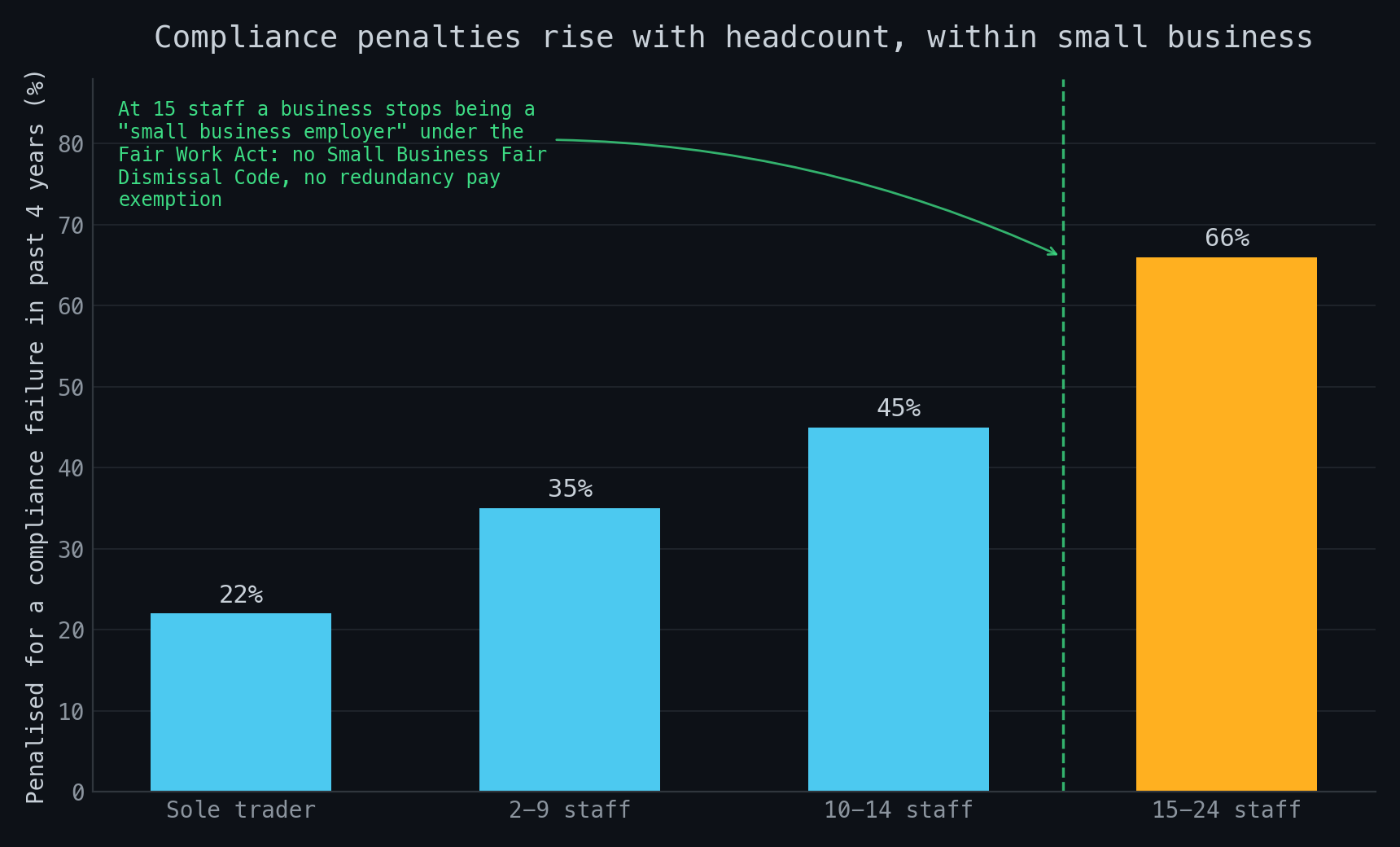
Read that chart carefully, because it is easy to misread. It does not show that larger businesses are worse at compliance. It shows that as a business crosses from sole trader to a handful of staff to fifteen, it acquires obligations faster than it acquires the capacity to administer them. A sole trader has no award to interpret, no superannuation guarantee to remit for anyone else and no payroll to report. At fifteen staff, the same person now has all of those plus a set of Fair Work obligations that a smaller employer is exempt from — and a 66 per cent chance of having been penalised.
GST and the threshold that stopped moving
A business must register for GST once its annual turnover reaches $75,000, and must do so within 21 days of crossing that line. For a non-profit body the figure is $150,000. Registration brings the business activity statement: quarterly for businesses with GST turnover under $20 million, monthly above that.
The $75,000 figure has been in place since 1 July 2007. It is not indexed. A business turning over $75,000 in 2007 and a business turning over $75,000 today are not the same business in any economically meaningful sense, but they have identical GST obligations. The practical effect is that the registration threshold has been quietly falling in real terms for nineteen years, drawing progressively smaller operators into quarterly BAS reporting without any decision ever being taken to do so.
The BAS itself is not, in isolation, an enormous task. The problem the accounting bodies identify is overlap. CPA Australia’s December 2025 submission to the Board of Taxation’s Red Tape Reduction Review points out that the BAS, Single Touch Payroll finalisation, the Taxable Payments Annual Report, payroll tax returns and workers compensation reporting all require substantially similar payroll data — wages, allowances, superannuation, contractor payments — in different formats, on different cycles, to different agencies. The information has already been supplied; the work is in reformatting it.
That submission also contains the sharpest example of a compliance trap I found. A family trust election, once made, cannot easily be amended to reflect a death, an intergenerational change or a genuine administrative error. A paperwork mistake can trigger family trust distribution tax at 47 per cent, and the Commissioner has no discretion to remit it. CPA Australia notes that the ATO’s own systems do not consistently record historical elections, so an adviser may not know an election exists.
Payday Super: the seven-day rule
The superannuation guarantee rate reached 12 per cent on 1 July 2025, the last of the legislated increases. The rate is not what changed this year. The timing is.
Until 30 June 2026, an employer could pay superannuation quarterly, with contributions required to reach the fund within 28 days of the end of the quarter — due dates of 28 October, 28 January, 28 April and 28 July. From 1 July 2026, under Payday Super, contributions must be received by the employee’s fund within seven business days of each payday, with enough information attached for the fund to allocate them to the right member account. The deadline for a new employee’s first contribution is 20 business days.
Three details make this harder than it sounds.
First, the deadline is measured at the receiving end. It is not satisfied by the employer initiating a payment within seven business days; the money and the data must arrive at the fund. An employer paying weekly now has 52 of these deadlines a year instead of four, each dependent on the clearing house, the payment rails and the accuracy of employee fund details. To make this feasible, the SuperStream data and payment standards were revised to allow near-real-time payments over the New Payments Platform and to add a member verification request so employers can check fund details before sending money.
Second, the base changed. Superannuation is now calculated on “qualifying earnings” rather than ordinary time earnings. Qualifying earnings bring in all commissions and salary-sacrificed amounts, among other payments. An employer who calculated 12 per cent of the same figure they used last year will underpay.
Third, the free tool went away. The ATO’s Small Business Superannuation Clearing House closed to new users on 1 October 2025 and ceased entirely on 30 June 2026 — the day before the seven-day rule commenced. Small employers who relied on it must now use a commercial clearing house or their default fund’s facility.
The penalty architecture was rebuilt at the same time, and not uniformly in the employer’s favour. Under the old system the superannuation guarantee charge was self-assessed: a late employer lodged a statement, and the charge carried interest at 10 per cent a year plus a flat administration fee, and was not tax deductible. Under the new system the ATO assesses the charge itself — there is no statement to lodge — and it carries interest that compounds daily at the general interest charge rate, plus an “administrative uplift amount” that can be reduced by voluntary disclosure and a clean history. The charge is now tax deductible, which it was not before. Penalties on top of the charge fell from a maximum of 200 per cent to 25 or 50 per cent depending on prior penalties.
So the regime is in some respects more forgiving and in others considerably less. Interest that compounds daily on an assessment raised automatically by the ATO is a different risk profile from a flat fee on a self-lodged statement, particularly for a business whose failure mode is not dishonesty but a fortnight of not opening the post.
Payroll tax: one tax, eight regimes
Payroll tax is a state and territory tax. There are eight of them, and they do not agree on the threshold, the rate, the phase-out, or the point at which businesses must be grouped and assessed together.
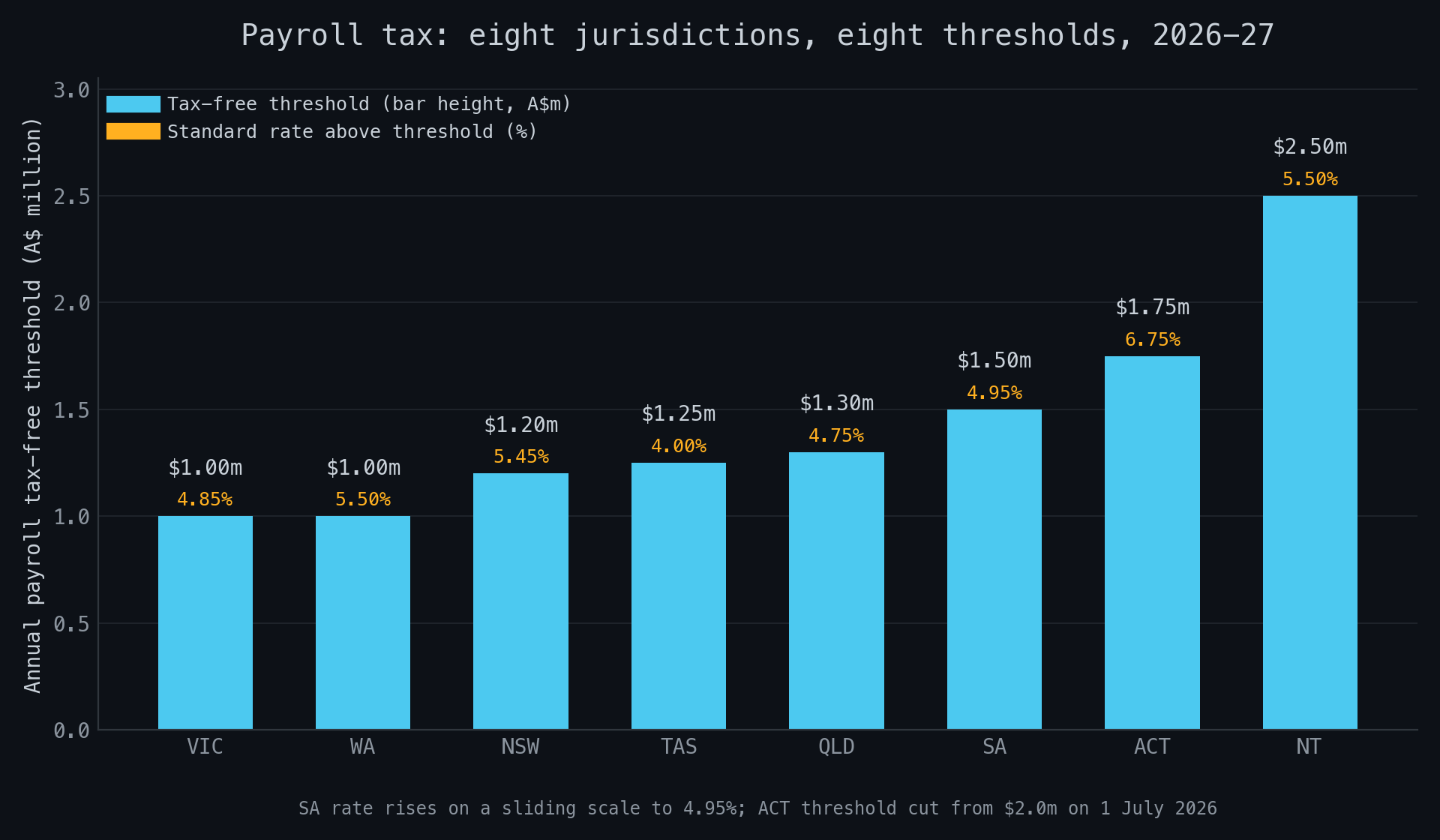
The threshold spread is two and a half to one. A business with a $1.4 million wage bill pays payroll tax in Victoria, Western Australia, New South Wales, Tasmania and Queensland, and pays none in South Australia, the ACT or the Northern Territory. The rate spread runs from 4 per cent in Tasmania’s lower band to 6.75 per cent in the ACT’s first band.
The phase-out rules differ again, and they are where the real complexity sits. Victoria reduces the tax-free deduction for employers with Australian wages between $3 million and $5 million and removes it entirely above $5 million. Queensland cuts the deduction by $1 for every $7 of wages above $1.3 million, reaching zero at $10.4 million. Western Australia tapers its threshold between $1 million and $7.5 million. Tasmania runs two brackets, 4 per cent from $1.25 million and 6.1 per cent above $2 million.
One change on 1 July 2026 is worth isolating. The ACT cut its threshold from $2 million to $1.75 million, which is a tax increase achieved without touching a rate: employers with wage bills between those figures became payroll taxpayers, with registration, monthly returns and an annual reconciliation to match.
By contrast, New South Wales has held its threshold at $1.2 million and its rate at 5.45 per cent every year since 2022-23. Holding a threshold flat through a period of significant wage inflation is, in substance, the same manoeuvre the ACT performed explicitly — it just does not require an announcement.
For a business operating across a state line, none of this harmonises. CPA Australia’s submission notes the same duplication across portable long service leave, workers compensation and payroll tax: different registrations, different definitions, different lodgement dates, for the same employees.
Awards, and the wage decision at the bottom
Modern awards set minimum pay and conditions by industry and occupation. The Fair Work Commission’s Annual Wage Review 2026 decision, announced on 2 June 2026 and operative from 1 July, records that approximately 21.1 per cent of all Australian employees — almost 2.8 million people — are paid at an award minimum rate. That workforce is over 60 per cent female, over 70 per cent part-time, more than half casual, and concentrated: accommodation and food services, health care and social assistance, retail trade and administrative and support services account for over two-thirds of it.
The headline outcome was a 4.75 per cent increase to modern award wage rates. The number that matters more to a small employer in hospitality or retail is a different one.
The Commission also made a structural adjustment to the lowest classifications. It has decided to phase out the C13 classification — the lowest rate applicable to ongoing employment — over three years, making C12 the floor. The first stage lifted the C13 rate by the 4.75 per cent plus an additional one-third of the gap between C13 and C12, with C14 (the entry-level rate, applicable for no more than six months) rising by the same percentage to preserve its relativity. The result is a lowest ongoing award rate of $1,004.90 a week, or $26.44 an hour, and an entry-level rate of $978.10 a week, or $25.74 an hour. The Commission estimates this affects around 100,000 of the lowest-paid employees.
The National Minimum Wage is aligned to C13, so it moved to the same $1,004.90 a week. Against the $948.00 a week that applied from 1 July 2025, that is an increase of 6.0 per cent, not 4.75 per cent.
The distributional logic is sound — the Commission is compressing the bottom of the scale to protect the lowest paid, and says so plainly. The point for this piece is that a business whose staff sit at the bottom of the award structure received a wage increase roughly a quarter larger than the headline figure, in a year when the same business also absorbed the payday superannuation transition. A café with entry-level staff is precisely the business at the intersection.
The Commission was candid about the economics. It noted the Reserve Bank’s forecast of 4.8 per cent headline inflation for the year to June 2026, and said it would take a rise of well over 5 per cent to close the real wage gap that has opened since 2021. It concluded, in its own words, that awarding that much would not be “practicable or responsible” given the uncertainty following the disruption to oil supplies from the conflict that began on 28 February 2026. It acknowledged a higher risk to employment in the accommodation and food services sector specifically.
Why the award itself is the burden
The wage rate is the simple part. An award does not state one number; it states a base rate per classification, modified by penalty rates for evenings, weekends and public holidays, by casual loading, by junior rates scaled to age, by overtime, by allowances and by minimum engagement periods. Getting a fortnight’s pay right for four casual staff working variable shifts is a calculation with dozens of inputs, all of which changed on 1 July.
The ACCI survey found award interpretation to be the single most-cited workforce compliance burden at 36 per cent, ahead of superannuation at 34 per cent and pay generally at 33 per cent.
Penalty rates themselves were locked in place by the Fair Work Amendment (Protecting Penalty and Overtime Rates) Act 2025, which received assent on 29 August 2025. It requires the Commission to ensure award penalty and overtime rates are not reduced, and prevents terms that substitute them with an arrangement leaving an employee worse off. The government stated it protects the rates of 2.6 million workers. Its effect on employers is to close off the one direction in which award complexity could have been simplified, since simplification proposals had generally involved rolled-up or averaged rates.
Underpayment as a criminal offence
Since 1 January 2025, intentionally underpaying an employee’s wages or entitlements has been a criminal offence. The maximum is 10 years’ imprisonment. For an individual, the fine is the greater of three times the underpayment and $1.65 million; for a company, the greater of three times the underpayment and $8.25 million.
The offence requires intent. Honest mistakes are not captured, and this is stated explicitly by the Fair Work Ombudsman. Small employers have an additional protection: the Voluntary Small Business Wage Compliance Code, registered on 16 December 2024, shields an employer with fewer than 15 employees from criminal referral if they have complied with it. Civil penalty exposure remains regardless.
Both safeguards are real. But they place the small employer in an unusual position: the defence against a criminal charge is documentary evidence of having tried to get a complex calculation right. That is a records-keeping obligation with a custodial sentence at the far end of it, discharged by a person who is also the one doing the rostering.
Thresholds as cliffs
Australian small business regulation is built on headcount and turnover thresholds. Each is a step, not a slope, and the steps are where the cost concentrates.
| Threshold | What crossing it triggers |
|---|---|
| $75,000 turnover | Compulsory GST registration within 21 days; quarterly BAS cycle begins |
| 15 employees | Business ceases to be a “small business employer” under the Fair Work Act: loses the Small Business Fair Dismissal Code, loses the redundancy pay exemption, and the unfair dismissal qualifying period for employees drops from 12 months to 6 |
| $1.0m–$2.5m wages | Payroll tax registration, monthly returns and annual reconciliation, at a threshold depending on jurisdiction |
| $10m turnover | Loss of small business entity status for tax concessions including the instant asset write-off |
| $20m GST turnover | BAS reporting moves from quarterly to monthly |
The 15-employee line is the one that shapes behaviour most visibly. It is the point at which employing one more person changes the legal character of every dismissal decision the business will make. The ACCI report identifies businesses with 15 to 24 employees as bearing the heaviest psychological load — 52 per cent reporting high stress against 39 per cent among smaller firms — and attributes it directly to sitting just over these regulatory lines.
Rules that expire every year
The instant asset write-off lets a small business with aggregated turnover under $10 million immediately deduct eligible assets costing less than $20,000, rather than depreciating them. Assets at or above $20,000 go into a general small business pool, depreciated at 15 per cent in the first year and 30 per cent thereafter.
The measure has been extended one year at a time. The current version covers assets first used or installed ready for use between 1 July 2025 and 30 June 2026, and was legislated by the Treasury Laws Amendment (Strengthening Financial Systems and Other Measures) Act 2025. In the 2026-27 Budget on 12 May 2026, the government announced it would make the $20,000 write-off permanent from 1 July 2026, in the Treasury Laws Amendment (Tax Reform No. 2) Bill 2026. As at the start of August 2026, that Bill had not passed.
A business deciding in August whether to buy a $15,000 piece of equipment therefore does not know its tax treatment. This has been the position, in some form, every year for several years. The measure is repeatedly justified as reducing compliance costs for small business, and in its steady state it does. Legislating it annually, often after the year has begun, converts a simplification into a planning problem.
The Board of Taxation’s Red Tape Reduction Review, announced on 24 September 2025, was due to report to government by 30 June 2026 after consulting more than 100 stakeholders and receiving 52 written submissions. Its report had not been published as at early August 2026.
What it adds up to
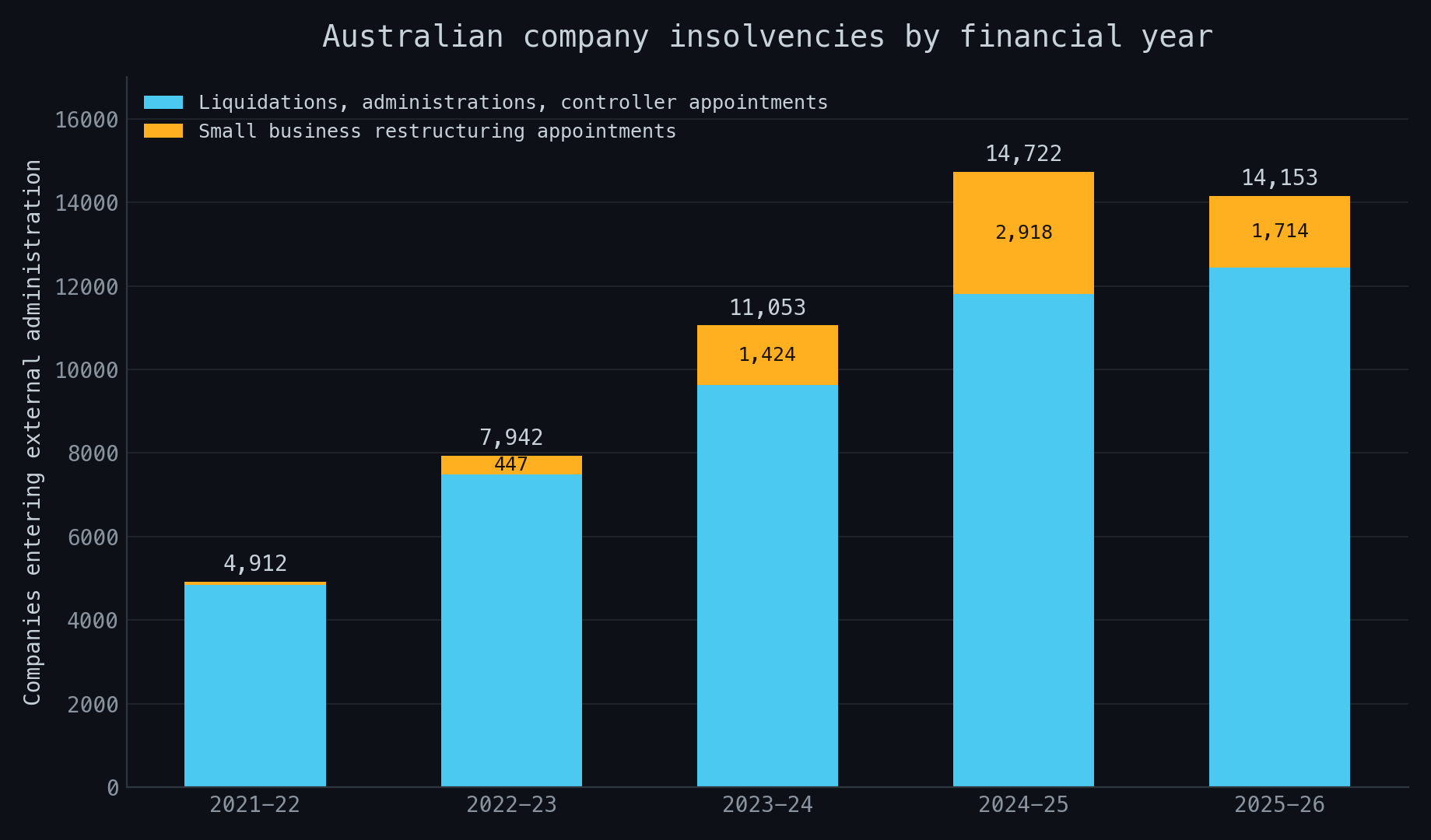
Company insolvencies nearly tripled between 2021-22 and 2024-25, from 4,912 to 14,722. The 2025-26 figure of 14,153 is a slight fall from that peak, not a return to anything normal. ASIC’s own framing is worth keeping: as at 28 February 2026, the ratio of companies entering external administration to registered companies was 0.40 per cent, below the 0.56 per cent and 0.53 per cent peaks of 2011-12 and 2012-13. In proportional terms this is a bad period, not an unprecedented one — the absolute numbers are records mainly because there are far more companies than there used to be.
The small business restructuring process, the simplified debt restructuring pathway for companies with liabilities under $1 million, went from 70 appointments in 2021-22 to 2,918 in 2024-25 before falling to 1,714 in 2025-26. In the first eight months of 2025-26 construction accounted for 24 per cent of all appointments and accommodation and food services 15 per cent — the two sectors most exposed to, respectively, fixed-price contracts against rising input costs and award-reliant labour.
I want to be careful here. Insolvency data records that a company failed; it does not record why, and no responsible reading of these numbers attributes them to compliance costs. The dominant causes over this period were the withdrawal of pandemic support, ATO debt recovery resuming after a long pause, interest rates and input costs. Compliance burden belongs in the list of pressures, not at the top of it.
What the survey data supports is narrower and still substantial: 28 per cent of small businesses had considered closing in the previous year, and 30 per cent were worried they might close within the next twelve months. Forty-four per cent of owners and managers reported high stress levels, rising to 52 per cent in firms with 15 to 24 staff.
Limitations
The strongest evidence in this piece — the ACCI figures on hours, costs and penalties — comes from a self-reported survey of 1,136 businesses commissioned by an employer organisation and published with support from a company that sells accounting software. That does not make it wrong; the methodology is disclosed and the sample size is respectable. It does mean the respondents are people who chose to answer a survey about business conditions, and self-reported hours spent on paperwork are an estimate, not a measurement.
“More than $20,000 a year on compliance-related expenses” is also a broad category. It will include accountant and bookkeeper fees that any business would incur to know its own financial position, independently of any regulatory requirement.
Australia has no current, comprehensive official measurement of small business tax compliance costs. The Board of Taxation’s last substantial study of the question dates to 2008, and its 2026 review had not reported when this was written. The absence of a recent official number is itself notable, given how often the burden is invoked on both sides of the argument.
Payroll tax thresholds and rates change with state budgets. Everything here is the 2026-27 position as published at the start of August 2026. The ACT figure in particular changed on 1 July 2026, and some consolidated comparison tables — including the joint payrolltax.gov.au table, last updated on 9 June 2026 — still showed the old $2 million threshold and 6.85 per cent rate. Where a jurisdiction’s own site and the joint table disagreed, I have used the jurisdiction’s own.
Practical notes
- Check whether your payroll software calculates superannuation on qualifying earnings rather than ordinary time earnings. Commissions and salary-sacrificed amounts are now in the base. A system still using the old base will underpay every cycle.
- Verify employee fund details before the first payday under the new rules, using the member verification request added to SuperStream. A rejected contribution that has to be re-sent can consume the seven business days on its own.
- If you used the Small Business Superannuation Clearing House, you needed a replacement by 1 July 2026. Confirm the replacement’s cut-off times, which are what actually determine whether money reaches the fund inside the deadline.
- Calculate your Australian-wide annual wage bill, not your state one, and compare it against the threshold in every jurisdiction where you pay wages. Grouping rules can aggregate related entities you think of as separate.
- If you are in the ACT with a wage bill between $1.75 million and $2 million, you became a payroll taxpayer on 1 July 2026 and may not have been told.
- Apply the 1 July 2026 award increases from the first full pay period starting on or after that date. If your staff are at C13 or C14 classifications, the increase is about 6 per cent, not 4.75 per cent.
- Read the Voluntary Small Business Wage Compliance Code if you have fewer than 15 employees, and keep the records it describes. It is the documented protection against criminal referral for an underpayment.
- Do not assume the instant asset write-off will apply to a purchase made this financial year until the Bill passes.
Edition 3 covers economies of scale: why large organisations win on price, what buying power and shareholder-profit optimisation actually consist of, and what is lost in quality, service and community when they do.
Sources
- Fair Work Commission, Annual Wage Review 2026 — Announcement of Decision, 2 June 2026.
- Fair Work Commission, Annual Wage Review 2026, case page, accessed 4 August 2026.
- Fair Work Ombudsman, “Minimum wage increase starts today”, 1 July 2025.
- Fair Work Ombudsman, “Protecting Penalty and Overtime Rates: Fair Work Act changes”, on the Act assented 29 August 2025.
- Fair Work Ombudsman, “Criminalising wage underpayments and other issues”, accessed 4 August 2026.
- Fair Work Ombudsman, “Who doesn’t get redundancy pay”, on the small business employer definition, accessed 4 August 2026.
- Australian Taxation Office, “About Payday Super”, last updated 9 July 2026.
- Australian Taxation Office, “Registering for GST”, accessed 4 August 2026.
- Australian Taxation Office, “$20,000 instant asset write-off for 2025–26”, published 3 February 2026.
- ASIC, Australian insolvency statistics — Series 1 and Series 2, released 27 July 2026 (data to 12 July 2026).
- ASIC, Corporate Insolvency Update — Issue 39, March 2026.
- Australian Chamber of Commerce and Industry, 2025 Small Business Conditions Report, survey of 1,136 businesses by Lonergan Research, 2025.
- CPA Australia, submission to the Board of Taxation Red Tape Reduction Review, 15 December 2025.
- Board of Taxation, Red Tape Reduction Review, announced 24 September 2025, accessed 4 August 2026.
- Australian Small Business and Family Enterprise Ombudsman, Number of small businesses in Australia, from ABS Counts of Australian Businesses, June 2025.
- Revenue NSW, “Payroll tax thresholds and rates”, accessed 4 August 2026.
- State Revenue Office Victoria, “Payroll tax current rates”, accessed 4 August 2026.
- Queensland Revenue Office, “Payroll tax rates and thresholds”, accessed 4 August 2026.
- RevenueWA, “Calculation: Payroll tax employer guide”, accessed 4 August 2026.
- State Revenue Office Tasmania, “Rates and thresholds”, accessed 4 August 2026.
- ACT Revenue Office, “About payroll tax”, accessed 4 August 2026.
- Payroll Tax Australia, “Payroll tax rates and thresholds”, joint revenue office table, last updated 9 June 2026.